
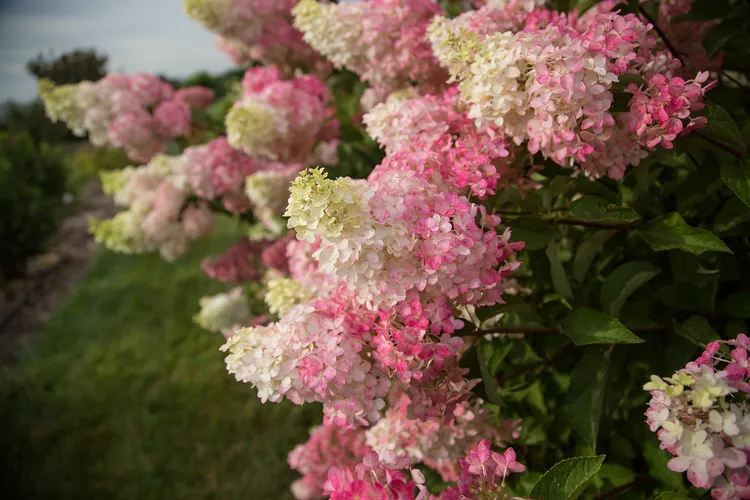
‘Berry White’ hydrangea is a variety of panicle hydrangea (Hydrangea paniculata) with pink and white flowers. It has strong, upright stems that are less likely to flop over from the weight of the many large blooms. The shrub starts blooming in mid-summer and lasts into the fall.
When they first bloom, the cone-shaped clusters of flowers open up white and then turn dark pink, starting with the flowers at the base of each cluster. It looks especially stunning when just some of the flowers have started to change color, leaving two-tone clusters of pink and white. At the end of the summer, all of the blooms will change to deep pink (almost red). Its deep, rich fall color will add interest to your landscape even when summer is over.
Hydrangea is toxic to humans and pets.
Berry White Panicle Hydrangea Overview
| Genus Name | Hydrangea paniculata 'Berry White' ('Renba' PP28,509) |
| Common Name | Berry White Panicle Hydrangea |
| Plant Type | Shrub |
| Light | Part Sun, Sun |
| Height | 6 to 7 feet |
| Width | 4 to 5 feet |
| Flower Color | Pink, White |
| Foliage Color | Blue/Green |
| Season Features | Colorful Fall Foliage, Summer Bloom |
| Special Features | Cut Flowers, Low Maintenance |
| Zones | 3, 4, 5, 6, 7, 8 |
| Problem Solvers | Good For Privacy |
Where to Plant ‘Berry White’ Hydrangeas
‘Berry White’ performs best in full sun or part shade and well-drained soil albeit with consistent moisture. It makes a wonderful addition to the landscape wherever these conditions are met, from mixed borders to foundation plantings. It is an excellent choice for creating a hedge or living screen in a garden. It can also be used in a cutting garden. The clusters of blooms are so large that three or four stems easily fill a vase.
'Berry White' is also suitable to be grown in containers.
How and When to Plant ‘Berry White’ Hydrangeas
Like other panicle hydrangeas, the best time to plant ‘Berry White’ is either in late autumn, just after the plant goes dormant, or in spring before it starts growing.
Dig a hole about twice the width of the pot and deep enough for the root ball to sit at the same depth as it was in its container. After filling in soil around the root ball, water deeply to help eliminate any air pockets.
Space plants 5 feet apart.
‘Berry White’ Hydrangea Care Tips
Light
‘Berry White’ hydrangea performs best in full sun with six to eight hours of direct sunlight every day, or in part shade. Morning-midday sunlight and dappled afternoon shade will produce the best blooms.
Soil and Water
If the soil is poor, add compost before planting. The soil should be well-drained, with a soil pH near neutral or slightly acidic (6.0 to 7.0). In this hydrangea, the flower color is not affected by soil pH.
Make sure the plant gets consistent moisture. Water enough so the soil never dries out and mulch around the base to preserve soil moisture. Lack of water is especially detrimental to the plant when the flower buds start to develop. Water the plant slowly and deeply at the base, not from overhead.
Temperature and Humidity
'Berry White' is extremely winter-hardy and survives frigid temperatures. In terms of summer temperatures, it is not suitable to be grown above Zone 8.
In high humidity, the foliage is susceptible to powdery mildew, especially if air circulation is poor.
Fertilizer
In late winter or early spring, fertilize once with a balanced, slow-release fertilizer for flowering trees and shrubs. Keep in mind that over-fertilizing hydrangeas produces a profusion of leaves instead of more blooms.
Pruning
Generally, this hydrangea needs little pruning other than to remove any dead or broken branches. Like other panicle hydrangea varieties, the best time to prune ‘Berry White’ is late winter or early spring (usually February or March) once the worst of the cold has passed.
To control the size of the shrub or to rejuvenate an older shrub. cut the plant back by about one-third. Panicle hydrangeas bloom on new wood so pruning encourages the plant to produce new stems and more flowers.
Potting and Repotting
'Berry White' is slightly on the large side but still suitable to be grown in a large container on a patio. Fill the container with a combination of potting mix and compost and make sure the container has adequate drainage holes. Like all container plants, it needs more frequent watering than plants in garden soil.
During the winter, keep the hydrangea outdoors but if you live in an area with freezing cold winters, you will have to insulate the roots against the cold. Move the container to a sheltered location such as an unheated garage or shed. The other option is to create a planting silo by wrapping the container in several layers of insulating material such as burlap or bubble wrap.
Repot the hydrangea to a large container when it starts to outgrow its pot, a sign of which is roots growing out of the drainage holes.
Pests and Problems
‘Berry White’ hydrangea are susceptible to aphids and Japanese beetles. Hand-pick larger pests like beetles from the plant and drop them into soapy water. A strong blast of water dislodges most pests. If that does not take care of the issue, use insecticidal soap.
Diseases that affect ‘Berry White’ hydrangeas include botrytis blight, caused by damp, cold conditions without much sunlight; bacterial leaf spot, and powdery mildew.
‘Berry White' is a hydrangea variety that is protected by a plant patent and may not be propagated in any form. even for personal use in your home garden.
Companion Plants for ‘Berry White’ Hydrangeas
Iris
Irises work well planted with ‘Berry White’ hydrangea because they require the same amount of sunlight and water. Irises also come in a variety of flower colors, so it's easy to find varieties that either complement or contrast with your hydrangea. Zone 3-11
Boxwood
Boxwood can be pruned and shaped in geometric designs, whether round or square. This orderly look would work well with the more dynamic style of ‘Berry White’ hydrangea, which grows with a more freeform aesthetic. In winter, when hydrangeas go dormant, evergreen boxwood provides interest to the landscape. Zone 4-8
Hosta
Try shade-loving hosta planted in front of ‘Berry White’ hydrangea, where it can grow comfortably, protected from the sun by the bigger plant. There are many types of hostas to choose from, ranging from blue-green leaves to bright yellow-striped ones. Zone 3-9