
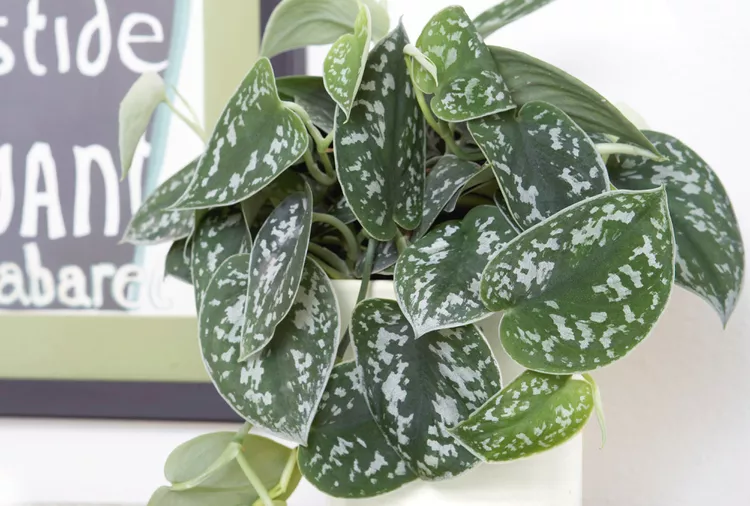
Any fan of low-maintenance houseplants should take a look at satin pothos (Scindapsus pictus). This vining plant boasts large, variegated blue-green leaves streaked with silver and gray and is a favorite to place on shelves or mantels, where the vines can cascade. From a botanical perspective, satin pothos is not related to pothos (Epipremnum aureum), which is another popular vining houseplant. Ready to bring home a satin pothos? This guide will help you grow it successfully.
Satin Pothos Overview
| Genus Name | Scindapsus pictus |
| Common Name | Satin Pothos |
| Additional Common Names | Silk pothos, Silver pothos |
| Plant Type | Houseplant |
| Light | Part Sun |
| Height | 4 to 10 feet |
| Width | 3 to 4 feet |
| Flower Color | White |
| Foliage Color | Blue/Green, Gray/Silver |
| Special Features | Good for Containers |
| Zones | 10, 11 |
| Propagation | Stem Cuttings |
Where to Plant Satin Pothos
Satin pothos is a vining plant that grows long stems (up to 10 feet!) and climbs up or hangs down, depending on the support it has. Provide space for it to spread out or guide it with a trellis or poles in the direction you'd like it to grow. It is also comfortable dangling over a shelf or desk. Satin pothos likes bright, indirect sunlight. Place it near a north- or east-facing window.
Satin pothos is toxic to dogs and cats when ingested. Put it in an area of your home where your pets can’t reach it.
Satin Pothos Care Tips
Low-maintenance satin pothos plants are easy to care for as long as their needs are met.
Light
Satin pothos plants thrive when they receive indirect bright sunlight for up to six hours a day. A north- or east-facing window is a good option for receiving sufficient indirect light. Make sure your silver pothos doesn’t receive direct sunlight, as too much sun can scorch the leaves and diminish the variegation.
Soil and Water
Satin pothos does best in well-draining soil. Use a potting mix for houseplants that contains perlite, peat moss, and pine bark.
Water when the first couple of inches of soil are dry; that’s your cue silver pothos is ready for another drink of water. Typically, you’ll water every week or two. The more light the plant receives, the more water it needs. Avoid overwatering or keeping your silver pothos in soggy soil, which can lead to root rot.
Temperature and Humidity
As a tropical plant, satin pothos likes warm, humid environments. The plant’s preferred temperature range is 65°F to 75°F. When exposed to drier environments, the tips of the leaves become brown. One way to increase the humidity is to put the pot over a tray full of water and pebbles, making sure the soil or roots are not in contact with the water. Another is to position a plant humidifier near the plant.
Fertilizer
Spring through fall, fertilize your silver pothos monthly with a balanced, liquid fertilizer formulated for houseplants, following the package instructions.
Pruning
Pruning the vines at the beginning of the growing season in spring can prompt leaf growth. Remove dead or damaged leaves at any time of year.
Potting and Repotting Silver Pothos
Choose a container with drainage holes and fill it with potting soil that contains perlite.
You’ll know it’s time to repot your satin pothos when roots begin to escape from the drainage holes. Repotting is best done in the spring and may be needed every year or every couple of years, depending on the growth rate of the plant. Opt for a pot that is an inch or two bigger than the current container, and add fresh potting soil.
Pests and Problems
Satin pothos is a hardy houseplant that doesn’t suffer from many pests or diseases. Sometimes, they are attacked by scale insects and spider mites. Check the foliage frequently, especially underneath the leaves, to reduce an infestation. If you spot only a few pests, wipe them away with a damp cloth. If there is a larger infestation, apply neem oil or insecticidal soap to the leaves.
Satin pothos can develop root rot if it is overwatered or the soil stays wet or soggy for long.
How to Propagate Satin Pothos
Propagating satin pothos is simple with a stem cutting.
During the spring or summer, snip a 4- to 6-inch stem cutting with at least two leaf nodes. Fill a spacious wide pot with potting soil, place the cutting over the soil, and carefully press the nodes down. Keep the soil moist and place the container in indirect light near the mother plant. New growth should appear after a month, which is a sign that the plant has rooted.
Types of Satin Pothos
‘Exotica’
Scindapsus pictus ‘Exotica’ has green, lance-shaped leaves as large as a person’s hand with lots of silver markings. ‘Exotica’ is an excellent houseplant, and its asymmetrical leaves add interest to its appearance.
‘Argyraeus’
Scindapsus pictus ‘Argyraeus’ has dark green leaves with more defined silver markings than many other varieties. The foliage is soft, and the contrast between the silver markings and green leaves is pronounced.
‘Silvery Ann’
Scindapsus pictus ‘Silvery Ann’ has soft foliage like ‘Argyraeus’ and a prominent silver variegation. At least half of each leaf is covered in silver speckles, and some are almost all silver. It is an excellent choice to creep up a wall.